

.JPG)
This year's Labor Day weekend proved to be busy as our Unit responded to multiple rescues from one end of the valley to the other. From Mt. Charleston to Lake Mead, we responded to various reports.
Saturday, August 30th
Two officers and one volunteer responded to reports of two hikers who had been hiking in Red Springs. After hiking for about 3 hours, the couple began scrambling up one of the faces where they ended up on a ledge where they could no longer climb up or down.
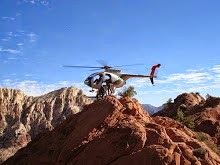
One officer and one volunteer hiked to the location of the climbers where they discovered them stranded, but with no injuries. Our Air Unit responded with the Huey and conducted a hoist rescue to retrieve the two stranded climbers from the ledge. They were transported to the parking lot.
Sunday, August 31st
At 0930, our unit responded to reports of an ATV accident in Cold Creek at Wheeler Pass. Two females had been riding on an ATV when it flipped over on them. One female complained of extreme back and hip pain while the second female sustained major facial injuries.
Two pilots, two officers, and one volunteer responded to the area in the Huey where they met the local volunteer fire department who had hiked to the patients. Medical care was provided to both patients while on the ground and each of the patients were transported by the Huey to Mercy Air who had been dispatched to the area.
The female driving the ATV was wearing a helmet, but broke her nose and orbital sockets as a result of the handle bar entering into the face shield area of the helmet. The female riding on the back of the ATV was not wearing a helmet and was crushed when the quad and driver rolled on top of her. She suffered a broken back and damage to one of her hips. Both were transported to UMC.
Shortly after responding to the ATV accident at Wheeler Pass, our unit responded to a hiker who had ledged out while hiking the closed Gold Strike Canyon trail at Lake Mead.
In an effort to enter the trail, the hiker parked and hiked from above the trailhead, dropping onto the trail. As he tried to slide his way down into the canyon, he ended up getting stranded about 60 feet from the floor of the canyon and was unable to climb up or down. The same crew that responded to Wheeler Pass also responded to Gold Strike Canyon.
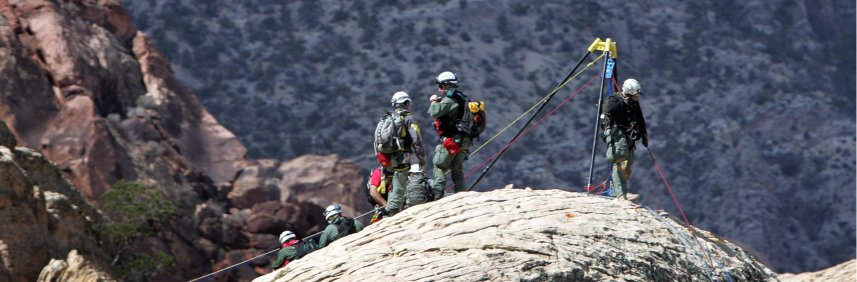
Because of the power lines located above the trail in Gold Strike, the crew was unable to conduct a hoist mission. Instead, one officer and one volunteer were dropped off above the hiker where the set up technical systems.
One rescuer was eventually lowered to the hiker where a pick-off was conducted. Once the hiker was secure, both the rescuer and hiker were lowered to the ground. No injuries were sustained and the hiker was ultimately handed off to NPS Rangers.


